
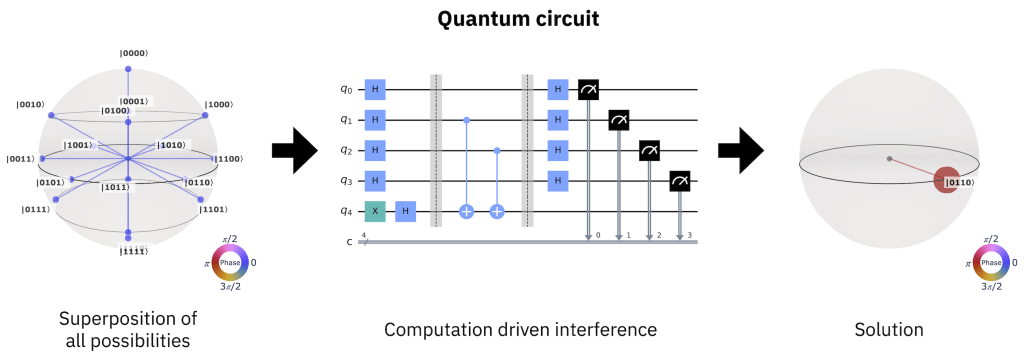
- Introduction
- Quantum Computing, What?
- How to Experience Quantum right now?
- Softwares to code quantum applications?
- Where are we right now with this #Use-case?
Introduction
Welcome to the world of Quantum and its weirdness. Well for starters, Quantum computing is at its very starting phase and if you are looking for a realtime use case, it will be little difficult to explain because the underlying technology in itself is quite complex to implement. Having said that there is no stopping the open source community and multiple big players (Google, IBM) and startups to start building apps around quantum computing and expand it the quantum ecosystem. So will cover some of the basic knowledge of IBM Q System One and its related software, Qiskit.
Quantum Computing, What?
In short, a new kind of computing. In the world of traditional classical computing, problems that are above and beyond certain size and complexity, we won’t be able to solve them using classical computers. Use of quantum computers is supposed to solve them primarily with the use of quantum mechanics principles like Superposition, Entanglement and Interference.
In short, in traditional computers, you have every letter, numbers or symbols which are represented in bits of either 1 or 0. In Quantum computing, these are represented as Qubits. Qubits can be in a 1 or 0 quantum state. But they can also be in a superposition of the 1 and 0 states. However, when qubits are measured the result is always either a 0 or a 1; the probabilities of the two outcomes depends on the quantum state they were in.
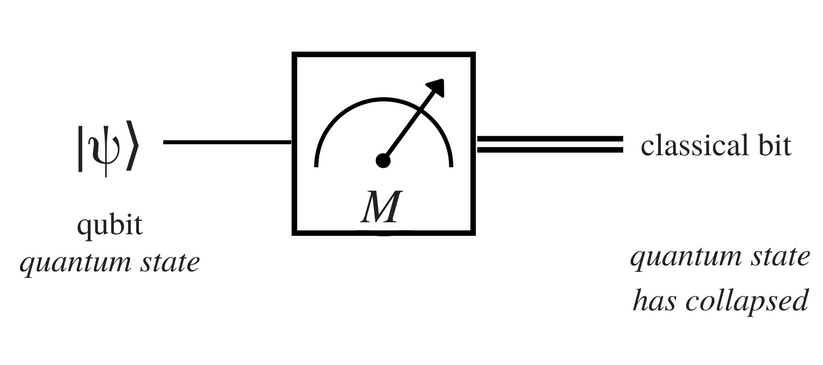
When you enter 1 or 0 to a quantum circuit, these 2 bits move into a quantum state of qubits. They tend to stay in that position until we measure them. The moment we measure them (in the image denoted by letter M), we get 2 bits out of it as in classical computing. Now the value which you receive will not be the same every time. It will depend on the state of the qubits at the time of measuring. hmm confusing isn’t it? Will cover more in the later blogs.
How to Experience Quantum right now?
Companies like IBM, DWave, and many other startups are looking to provide a platform to compute and build quantum solutions. IBM has recently released its own commercialised quantum computer IBM Q System One which is a gate based quantum computer and is available for both commercial and research.
With the help of IBM Q Experience, which is a quantum experience on the cloud. You can easily create interactive circuits and push the circuit to be calculated on the quantum computer.

A most simple circuit which I tried on the quantum computing system is on the left hand picture. What I have done is to take 2 bit and use H gate or Hadamard gate which helps in creating a quantum superposition.
Next is CX gate (the plus symbol) or controlled – NOT gate. It acts on a pair of qubits, with one acting as ‘control’ and the other as ‘target. It performs an X on the target whenever the control is in state |1⟩|1⟩. If the control qubit is in a superposition, this gate creates entanglement. And finally we measure the values of the state using the Z measurement.
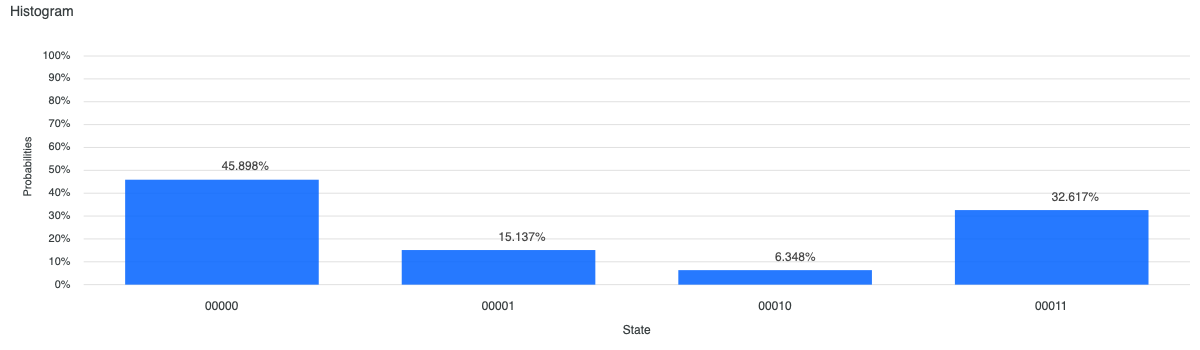
The final output is a probability of the quantum states which we have measured. We can see states 00000 and 00011 to be the states with most probability.
Softwares to code quantum applications?

Subscribe to continue reading
Subscribe to get access to the rest of this post and other subscriber-only content.
 Tech Spaghetti